 Better Vision
Korea's Crash, Japan's Exit: What Two Warning Signs Mean for American Markets
Two warning signs appeared last month. South Korea's stock market, driven mostly by AI-linked chipmakers, had one of the fastest crashes in its history. At nearly the same time, Japan's currency hit a 40-year low against the dollar, pushing Japan's central bank, the BOJ (Bank of Japan), to keep raising interest rates.
Korea's crash has a clear mechanical cause. Its main stock index, the KOSPI (South Korea's benchmark stock index, similar to our S&P 500), is more than half weighted in just two chipmakers, Samsung and SK Hynix. Regulators had also approved leveraged funds that let everyday investors double their bets on single stocks. When a regulator publicly called the market overheated, many leveraged investors got margin calls (demands to add cash or sell), which forced sales that triggered more margin calls in a spiral. The index went from a record high of 9,253 on June 22 to 5,593 by July 30, a drop of nearly 40% in about five weeks.
America has a smaller version of the same setup. The 10 largest companies in the S&P 500 (an index of America's 500 largest public companies) now make up about 37% of the entire index, and margin debt (money borrowed to buy stocks) sits near a record high. The US isn't as concentrated or leveraged as Korea was, but the mechanism is the same: if AI-related stocks stumble, a rotation away from them could hit the broader market harder than usual, since so much of the index rides on so few names.
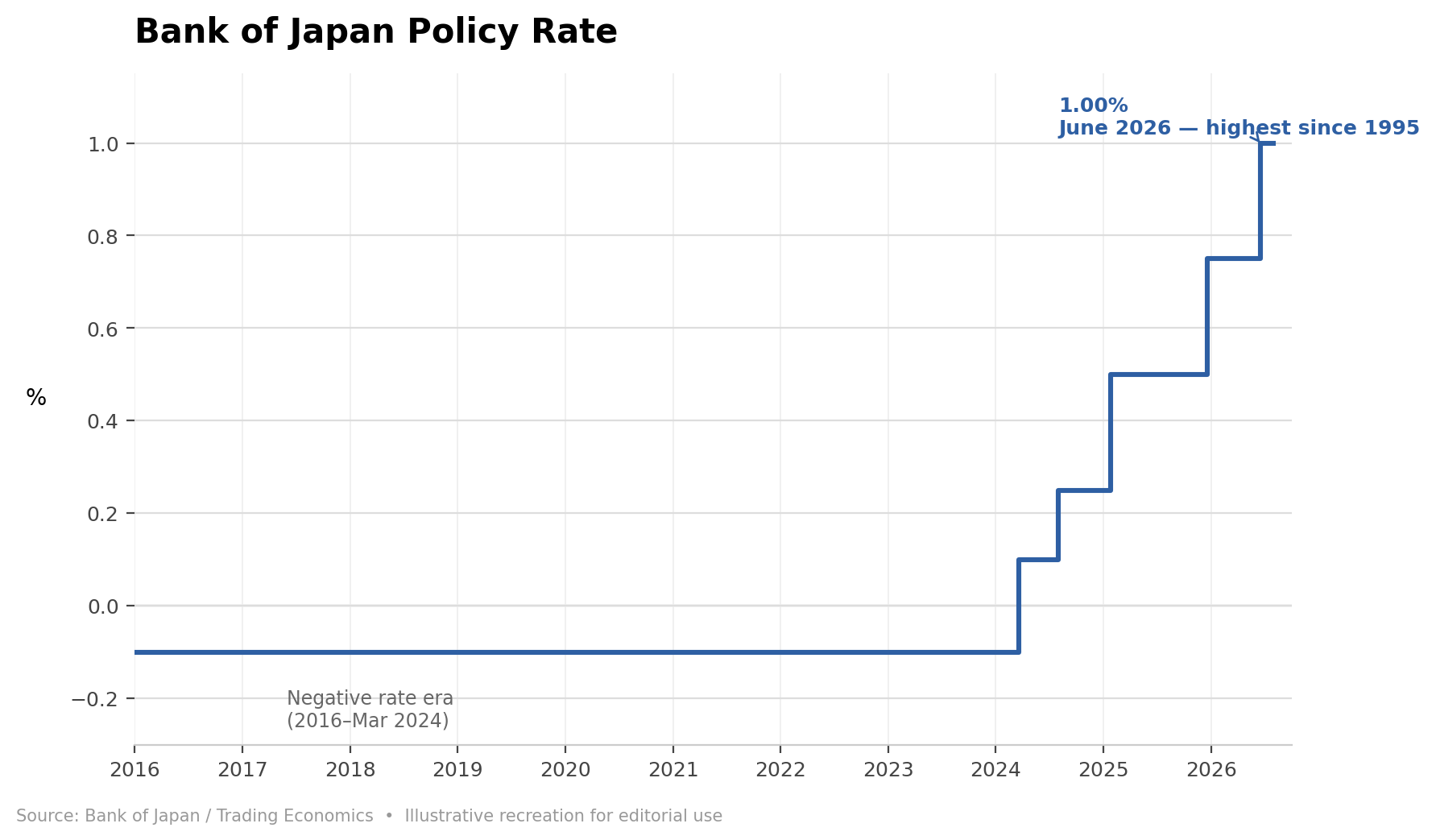
Japan's story is different, and arguably more serious for the US, because it isn't a rotation. It's money actually leaving. Japan has kept interest rates near zero, even going negative, for most of the past three decades. That gap against much higher US rates, especially since the Fed started aggressively raising rates in 2022, is what fueled the modern surge in yen-funded buying of American stocks and bonds. This is called the yen carry trade. As the BOJ raises rates to defend its currency, that trade is unwinding. Japan sold an estimated $60 billion in Treasuries in July, most of it in a single day, and Japan's giant public pension fund was directed to shift money out of foreign assets and back home. Japan is the largest foreign holder of US government debt, so its retreat matters, especially with about $8 trillion in US debt needing refinancing this year into some of the highest long-term rates since 2007.
Raising rates strengthens a currency because it raises the return investors earn for holding it. When the BOJ raises rates, yen savings and bonds pay more, so ideally, investors worldwide want to hold more yen to capture that return, which increases demand for yen and pushes its value up against the dollar. Higher rates also make it more expensive to borrow yen in the first place, which directly discourages the yen carry trade from continuing. Japan is doing this now because, for the first time in a generation, its economy can actually support it: inflation, wages, and a trade surplus are all rising together. The move has been gradual, and after ending negative rates in 2024, the BOJ raised its rate step by step to 1% in June 2026, the highest level since 1995, and held there at its July meeting even though one board member pushed to go further, to 1.25%.
A separate, cheaper option, simply selling dollars to buy yen, already cost $73.5 billion this spring; the yen bounced for a few weeks and then fell right back, because intervention only buys time and doesn't close the rate gap. Raising rates is the slower but more durable fix, though neither country is eager to do it: that same month, three Federal Reserve officials also dissented in favor of raising America's own rate.
The Japanese currency weakening, US Treasury intervention, and eventual impacts on stock and bond markets as the yen carry trade could start unwinding are not the only things to pay attention to. There's a direct line from this to American mortgage rates. Mortgages aren't priced off the Fed's rate; they track the 10-year Treasury yield plus a spread. Each time Japan sells Treasuries to raise dollars for a currency intervention, it adds selling pressure that pushes those yields, and mortgage rates, higher. The 30-year Treasury yield recently hit its highest level since 2007. In response, the US Treasury bought yen for the first time since 1998, funded by selling euros rather than bonds, and the Fed opened a special lending facility so Japan can defend the yen without dumping more Treasuries. Both moves buy time. Neither changes the rate gap actually driving the sell-off.
So last month we got to see two different exits. Korea shows how fast concentrated, leveraged bets unwind. Japan shows real money actually leaving American markets, and why: higher Japanese rates make holding yen more rewarding and holding dollars, by comparison, less so. Together, they point toward a weaker dollar ahead, and a real, if not yet alarming, question over who keeps buying American debt as one of its largest buyers pulls back.
A note on sources: This post isn't based on a single article. It was pieced together from a handful of YouTube videos covering the Korea crash and the yen carry trade unwind, cross-checked and organized from there. If you want to go to the primary discussions yourself:
- CDS calling BS on the entire hyperscaler trade — Nicholas Crown (Jul 27, 2026) — watch
- US Panic: Japan's Currency Just Exploded [Hint: Gold] — Felix & Friends (Goat Academy) (Jul 26, 2026) — watch
- South Korea's AI Bubble Just Collapsed — A Warning For America — Graham Stephan (Jul 27, 2026) — watch
- Japan's Money Is Collapsing — Andrei Jikh (Jul 28, 2026) — watch
- Gum in the Hoover Dam — Nicholas Crown (Aug 3, 2026) — watch